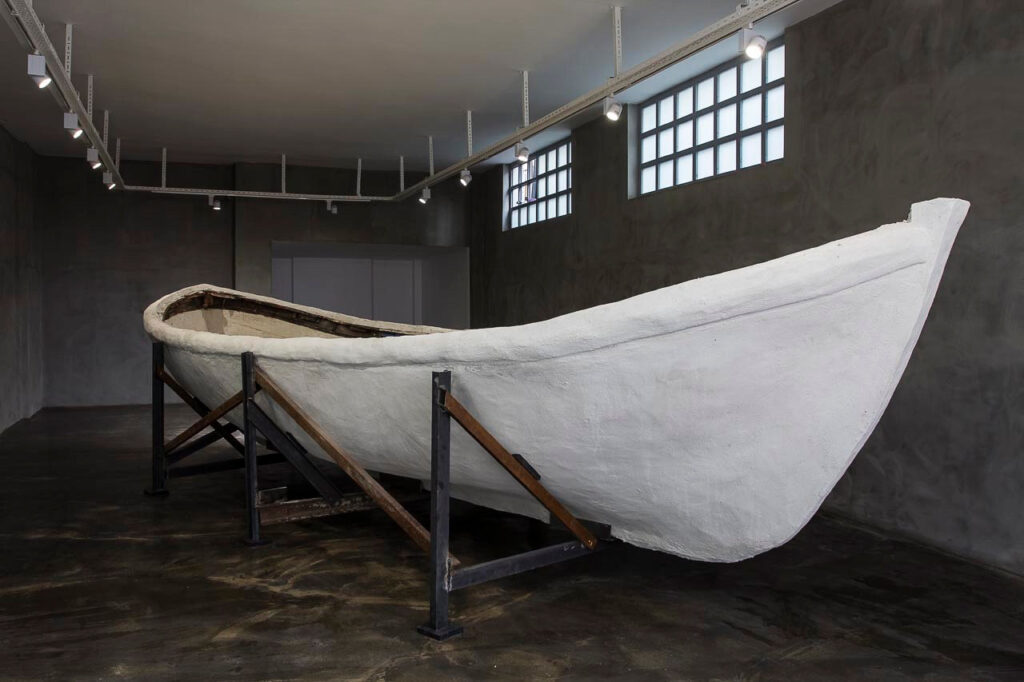
Openings to the Water I Stopped Searched for Cracks was produced with a group of art students from Sabancı University for Protocinema, Istanbul (2012). The project followed Concrete Boatbuilding II, conducted the previous summer as an extended research project investigating the history of ancient and contemporary Turkish boats in the Aegean and testing methods for casting a new hull from an existing wooden boat. Over three months, a 27-foot, nine-ton reinforced concrete hull was cast in a garage-studio using an abandoned wooden fishing boat found in Istanbul’s Yenikapı district as its mold. Located beside the archaeological excavations that uncovered the Byzantine harbor of Constantinople, the abandoned boat carried the traces of decades of repair, use, and exposure. Rather than reproducing the boat itself, the casting transferred its accumulated surface history into a new concrete vessel, following methods of ferrocement boatbuilding popularized as a do-it-yourself, countercultural practice during the 1960s and 1970s.
The title is a pastiche assembled from two unrelated narratives: Robert G. Skerrett’s “The Why and Wherefore of the Christening of Ships,” published in The Rudder (1919), itself quoting Père Scheil’s translation of the flood story in Tablet XI of the Epic of Gilgamesh; and the only account of the fishing boat that served as the mold, told by the daughter of the fisherman who had built and owned it. If objects tell stories, boats are unusual in that they accumulate biographies over time: under admiralty law a vessel can be named and sued as a defendant in its own right, charged with liability through maritime liens that attach to the hull itself, independent of its owner. The sculpture joins the histories of two boats — one old, one new — into a single form.


For extensive photo documentation of the process of building Openings to the water… see:
PHASE ONE: ORIGINAL BOAT PREP AND MOVING
PHASE THREE: MOVING AND DISPLAY
PHASE FOUR: FINAL LOCATION
We worked in a garage/studio from June to August 2012:


