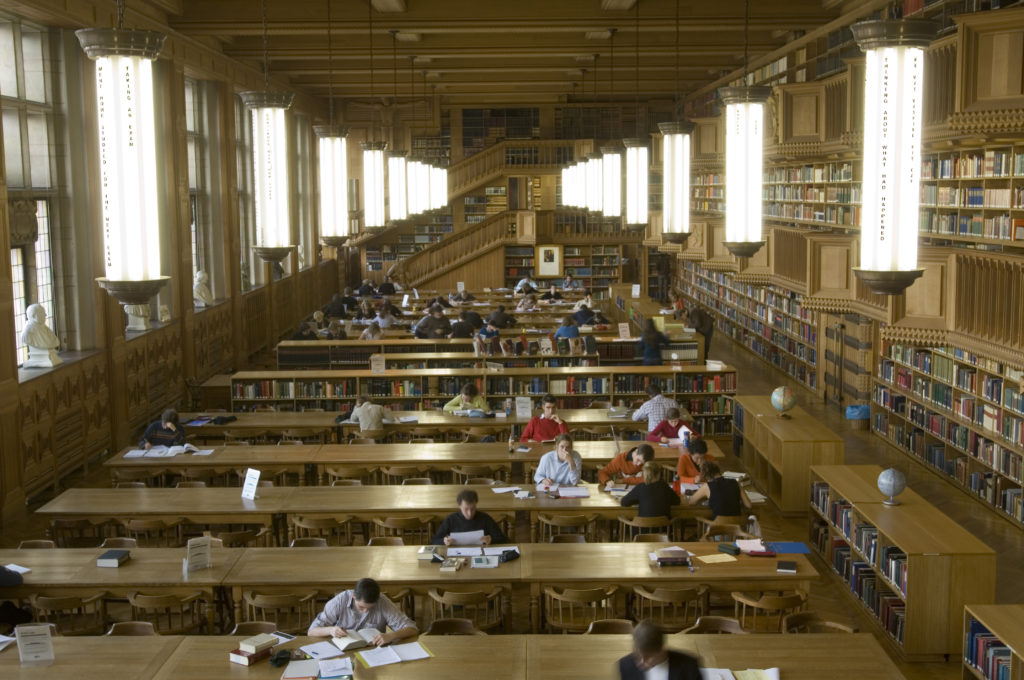
FLASHBULBS was installed in the main reading room (the Ladeuzezaal) of the Central Library of the University of Leuven, a building deliberately burned by German troops in 1914, rebuilt in 1928 as “America’s gift to Belgium,” largely destroyed again in 1940, reopened in 1951, and divided between the Flemish- and French-speaking universities in 1970. I surveyed library users for what psychologists term “flashbulb memories,” a concept based on the photographic metaphor that assumes memories of traumatic or historically significant events are formed and retained differently than ordinary memories. The resulting 168 texts (translated into English) were applied in vinyl lettering to the bulbs of the 28 lamps suspended across the library’s three reading rooms.
Each text described only the circumstances surrounding a remembered event — where the respondent was, what they were doing, who was present, and related details — but never identified the event itself. Because the bulbs were arranged around the central cores of the lamps, no single memory could be read in its entirety from any one position in the room. The words were instead encountered as an open text distributed throughout the library.
A book containing the collected texts and documentation of the project entered the library’s permanent collection.